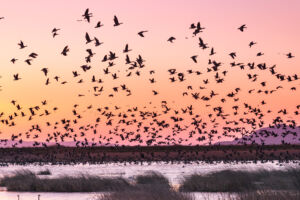
Image: masahiro - stock.adobe.com Morgendlicher Abflug der Zugvögel am Kaburaginu-See in Miyagi
News
Biodiversity Land Use

Animal Movement as an Early Warning System: Environmental Monitoring to Protect Biodiversity

Animal movement patterns shed light on the state of the environment. In the new LOEWE research cluster VEBITA, animal movement data is analyzed using AI methods to detect changes in biodiversity and establish proactive biodiversity conservation.

Animal movements play a central role in the stability of ecosystems and the adaptability of species in the face of global change. In the new LOEWE research cluster “Behavioral Plasticity in a Changing World: Biologging as the Key to Assessing Animal Adaptability (VEBITA),” researchers are using movement data and AI methods to investigate how animals respond to climate change and habitat changes. The Senckenberg Society for Nature Research, the Institute for Social-Ecological Research (ISOE), and Philipps University of Marburg are jointly investigating what implications can be drawn from environmental monitoring for research, nature conservation, and society. 

Gazelles that travel long distances across the Mongolian steppes in search of foraging grounds. Or migratory birds that travel thousands of kilometers each year between breeding and wintering grounds: Movement is a fundamental principle of animal life—it determines where animals find food, how they encounter mates, whether new habitats are opened up, and whether genetic exchange occurs between populations. Differences in movement patterns can therefore determine whether a species successfully adapts to environmental changes or goes extinct.

In other words, animal mobility also serves as a kind of early warning system for biodiversity. Long before a species faces a critical situation, changes in animals’ known movement patterns become apparent. The research team at the LOEWE VEBITA research cluster analyzes movement data from animal tracking tags (biologging data) using AI methods to systematically record patterns of animal mobility and changes in behavior. The goal is to better understand how animals respond to climate change, land-use changes, and habitat alterations.

The focus on dynamic adaptation and change in monitoring is a new approach; such transformative environmental monitoring has not yet played a role in observing species and their movement patterns. As a result, species threatened with extinction are often not identified until it is too late. For its innovative research approach, the VEBITA team draws on extensive existing datasets, particularly the global research database Movebank, which aggregates movement data from animal research worldwide. The state of Hesse will fund the project for four years starting in January 2027 with approximately 4.6 million euros. Participants include the Senckenberg Society for Nature Research (lead partner), the Institute for Social-Ecological Research (ISOE), Philipps University of Marburg, and other partners.

Translating Knowledge into Proactive Environmental Monitoring

ISOE contributes its expertise in transdisciplinary research to VEBITA, thereby linking the project’s scientific findings and their practical application. The goal is to develop meaningful early-warning indicators for nature conservation practice and to make this new, actionable knowledge available through so-called knowledge hubs. To this end, the ISOE involves stakeholders from nature conservation, public administration, politics, and business early in the research process to integrate their practical knowledge, problem understanding, and interests regarding future land-use practices.

In selected regions, early warning indicators and precautionary strategies for biodiversity conservation are being developed in close collaboration with local stakeholders based on specific case studies—on the one hand in Mongolia, which is considered a refuge for migrating gazelles, and on the other in Hesse, for example regarding the spread of avian influenza. The ISOE is also investigating the extent to which AI-generated indicators are accepted in practice. It is important for researchers to understand how obstacles can be overcome, particularly with regard to trust in the use of artificial intelligence.

Finally, at the European level, the ISOE engages stakeholders from politics, government, and business to ensure that the transformative monitoring developed during the research process can be utilized for the implementation of international and European regulations, such as the EU Nature Restoration Law.

Transdisciplinary Research for Better Decision-Making

VEBITA has a trans- and interdisciplinary structure and draws on an established national (Max Planck Institute for Behavioral Biology, MPIAB) and international (Smithsonian Conservation Biology Institute, SCBI) scientific network. In addition, the LOEWE research cluster involves practice partners from the private sector (KPMG Germany, d-fine), government organizations (Hessian State Office for Nature Conservation, Environment, and Geology, HLNUG), and nongovernmental organizations (Frankfurt Conservation Center (FCC); Hessian Society for Ornithology and Nature Conservation, HGON; Wildlife Science and Conservation Center of Mongolia, WSCCM).

Project

Contact:
Prof. Dr. Flurina Schneider: Wissenschaftliche Geschäftsführerin des ISOE

Prof. Dr. Flurina Schneider

Scientific Director Go to Profile

Melanie Neugart

Deputy Head of Science Communication and Knowledge Transfer, Focus Media Relations Go to Profile
Biodiversity

Biodiversity —

What are the causes of biodiversity loss? How can we protect biodiversity in the future? How can we create a willingness for change?

Go to Topic Page