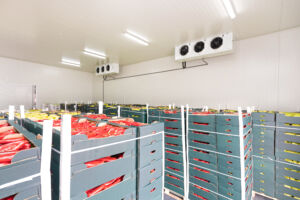
Artificial cooling already fundamentally shapes the world we live in today. A global network that is barely visible to us forms the backbone of our food and medicine supply, air-conditions our rooms, and enables our digital communication: the so-called artificial cryosphere. The CultCryo project team is investigating this infrastructure, which not only shapes our everyday lives but also has massive implications for future energy demand. Using interdisciplinary, international case studies on food, biobanks, data centers, and air conditioning, the research team is analyzing the cultural causes of the growing demand for cooling – with the aim of identifying ways out of the looming energy crisis and associated social injustice and rethinking how we deal with cold.
Almost everywhere in the world, cooling technologies have become an integral part of modern life. They secure the food supply, are indispensable for medicine, air-condition our buildings, and enable our digital communication. In doing so, they form a largely invisible but extremely energy-intensive global infrastructure of cold stores, cold chains, biobanks, data centers, and air-conditioned buildings – an artificial cryosphere. Because it fundamentally structures our everyday lives, this artificial cold network has far more than just technological or physical significance for us. Rather, it shapes lifestyles worldwide, but this cultural dimension has hardly been researched to date.
Global artificial cryosphere: What does cooling have to do with justice?
In the “CultCryo” research project, an international research team involving ISOE is investigating the artificial cryosphere for the first time. The researchers understand this global network not merely as a technical innovation, but as a cultural practice that transforms our social and ecological systems. In other words, cooling not only changes our consumption habits or how we understand health, but also our perception of time and space. By preserving products and objects – from food to egg cells – cooling also changes our understanding of transience. Spatial perception also changes when things are available everywhere, such as tropical fruits in winter, Argentine beef, or North Atlantic fish. However, access to this technology is extremely unevenly distributed worldwide. The team therefore asks: How does cooling influence our ideas of comfort, modernity, and social justice?
Cooling and climate change – a vicious circle
Looking to the future is particularly important for the research team. Cooling technologies already seem paradoxical: they are both a means of climate adaptation and a driver of global warming. In the short term, they protect people from rising temperatures. In the long term, however, they contribute to global and local warming through their immense energy consumption, the use of climate-damaging refrigerants, and waste heat. It is a vicious circle that the International Energy Agency (IEA) refers to as the “cold crunch.” According to forecasts, global cooling demand will increase fivefold by 2050. This “hunger for cold” would not only have devastating ecological consequences – It would also massively exacerbate the issue of global and social justice.
Cooling in a changing world: International case studies
The CultCryo project pursues an innovative mixed-methods approach that combines historical, geographical, ethnographic, and techno-philosophical perspectives. The focus is on four interdisciplinary case studies from the fields of food supply, air conditioning, biomedicine, and computer science. To this end, the research team is collecting ethnographic material in Australia, India, Europe, and the US. The aim is to conduct an intercultural comparison to examine how different societies use cooling technologies – or refrain from using them due to traditions and lack of access – and what social, political, and cultural consequences this has. Another goal is to identify more sustainable cooling alternatives. Among other things, ISOE is conducting ethnographic pilot studies in the areas of food and air conditioning.
More about the project
The project “Cultures of the Cryosphere – Infrastructures, Politics and Futures of Artificial Cooling” is funded by the European Research Council (ERC) as part of ERC Synergy Grant No. 101118625 (2024–2030). The project is led by the Technical University of Darmstadt. Project partners are the University of Paderborn, the Institute for Cultural Studies at the University of Duisburg-Essen, the Australian National University Canberra, the University of Hamburg, Martin Luther University Halle-Wittenberg, and the Institute for Social-Ecological Research (ISOE).
Contact: