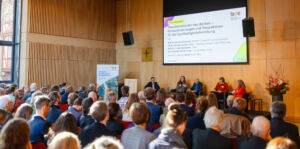
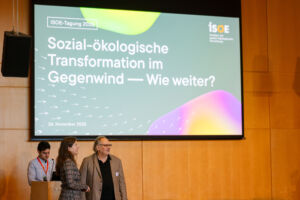
It’s like cycling: if you don’t face headwinds head-on, you won’t reach your destination.The Institute for Social-Ecological Research (ISOE) used headwinds as a metaphor for its conference and applied it to socio-political developments. Social-ecological sustainability research is currently facing headwinds. This is felt not only by researchers, but also by actors from business, associations, public administration, politics, and civil society who are committed to sustainability. So what next? More than 150 guests discussed this at the ISOE conference on November 26, 2025, at the Haus am Dom in Frankfurt.
“Social-ecological transformation in headwinds – What next?” The title of the ISOE conference did not promise easy answers, but it opened up an inspiring space for discussion for many who are watching the current sustainability discourse with concern: How can we deal with social and political developments that are causing sustainability issues to take a back seat, climate protection issues to virtually disappear from the agenda, and research on socially and ecologically necessary changes to be deliberately discredited?
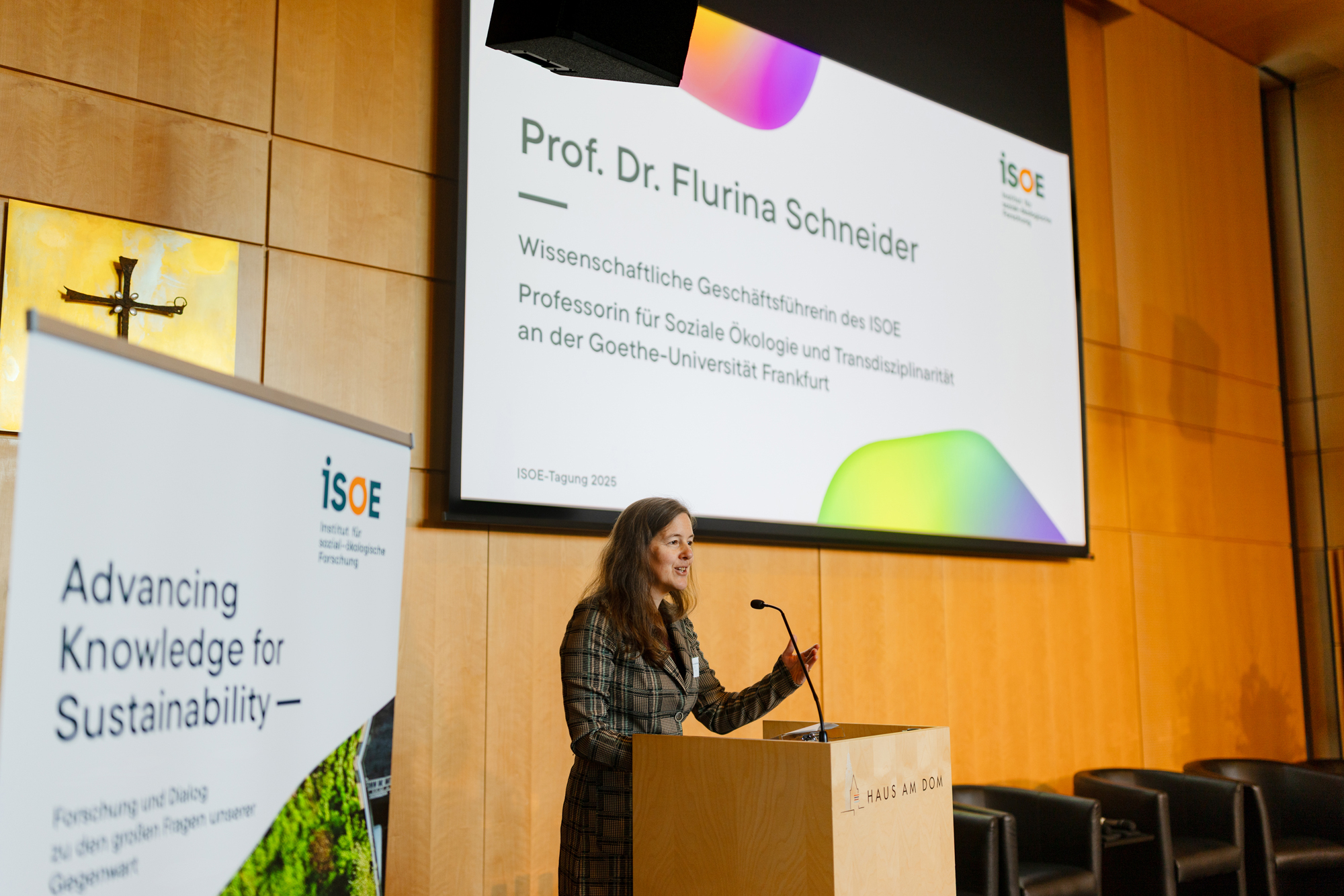
There are no simple answers to these questions – but there are many illustrative examples. In her welcoming speech, Flurina Schneider, Scientific Director of ISOE, mentioned the negotiations at COP30. These had ended shortly before the ISOE conference without any significant results and without sending a signal for the necessary phase-out of fossil fuels. In her speech, transformation researcher Flurina Schneider made it clear that this corresponds to a dynamic that has been emerging in sustainability policy for some time and is being exploited by right-wing populist movements:
“Progress and setbacks alternate at a rapid pace. This can also be observed in other areas such as biodiversity: until recently, various regulations were developed at the EU level with the aim of encouraging companies to do more to protect biodiversity. Many of these have been significantly watered down in recent months, most recently the EU Supply Chain Act, which was significantly weakened with the support of right-wing parties.”
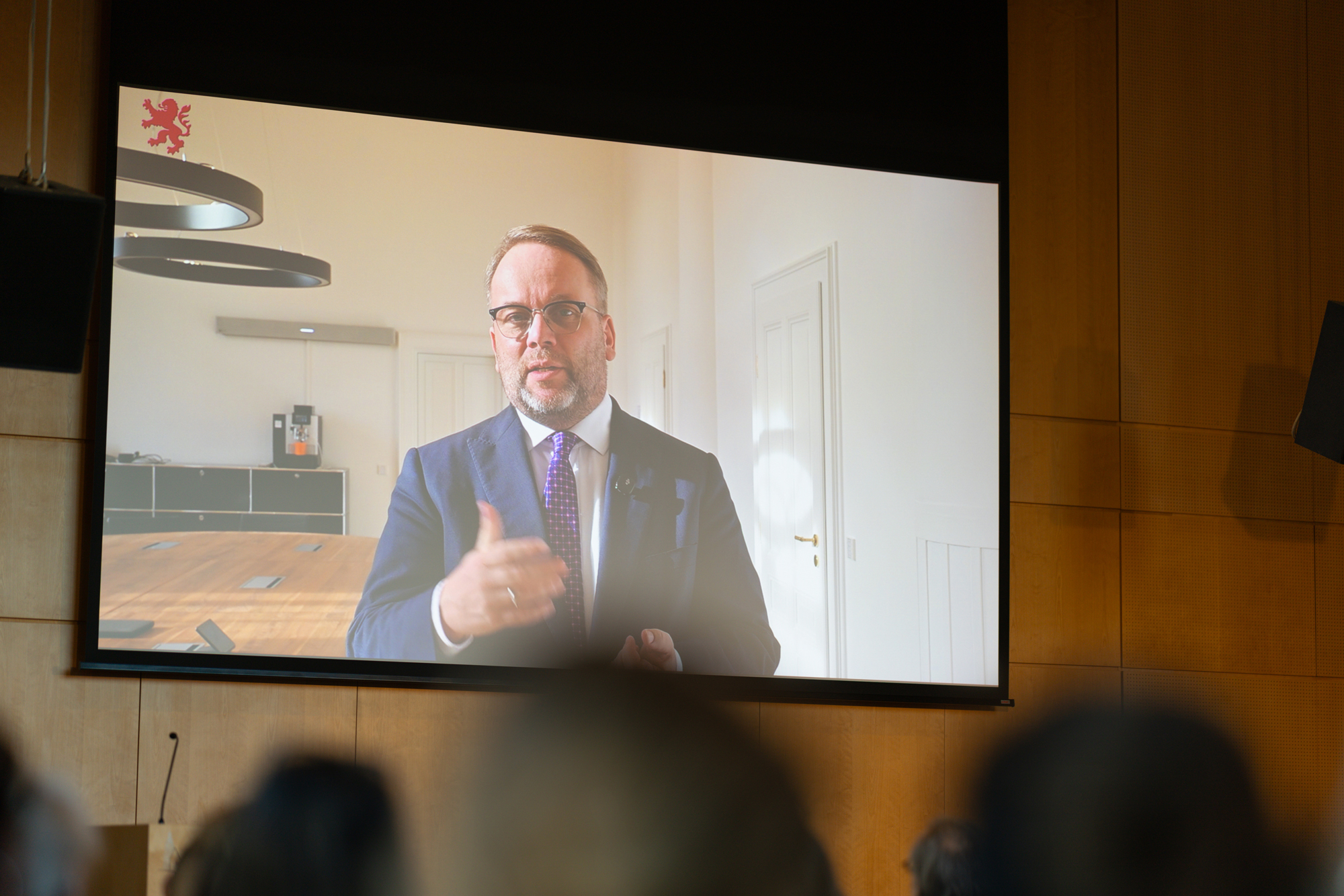
Timon Gremmels, Hessian Minister for Science and Research, Art and Culture (SPD), also pointed this out in his welcoming address to the conference guests:
“The winds have become harsher, and sustainability research, climate protection, and scientific findings are under pressure. Populist voices are growing louder, and the willingness to embrace change seems to be waning. In times like these, it is crucial that research not only provides insights, but also takes a stand against fake news, disinformation, and simplistic populist answers to complex questions.”
Populist movements are reshaping the transformation discourse
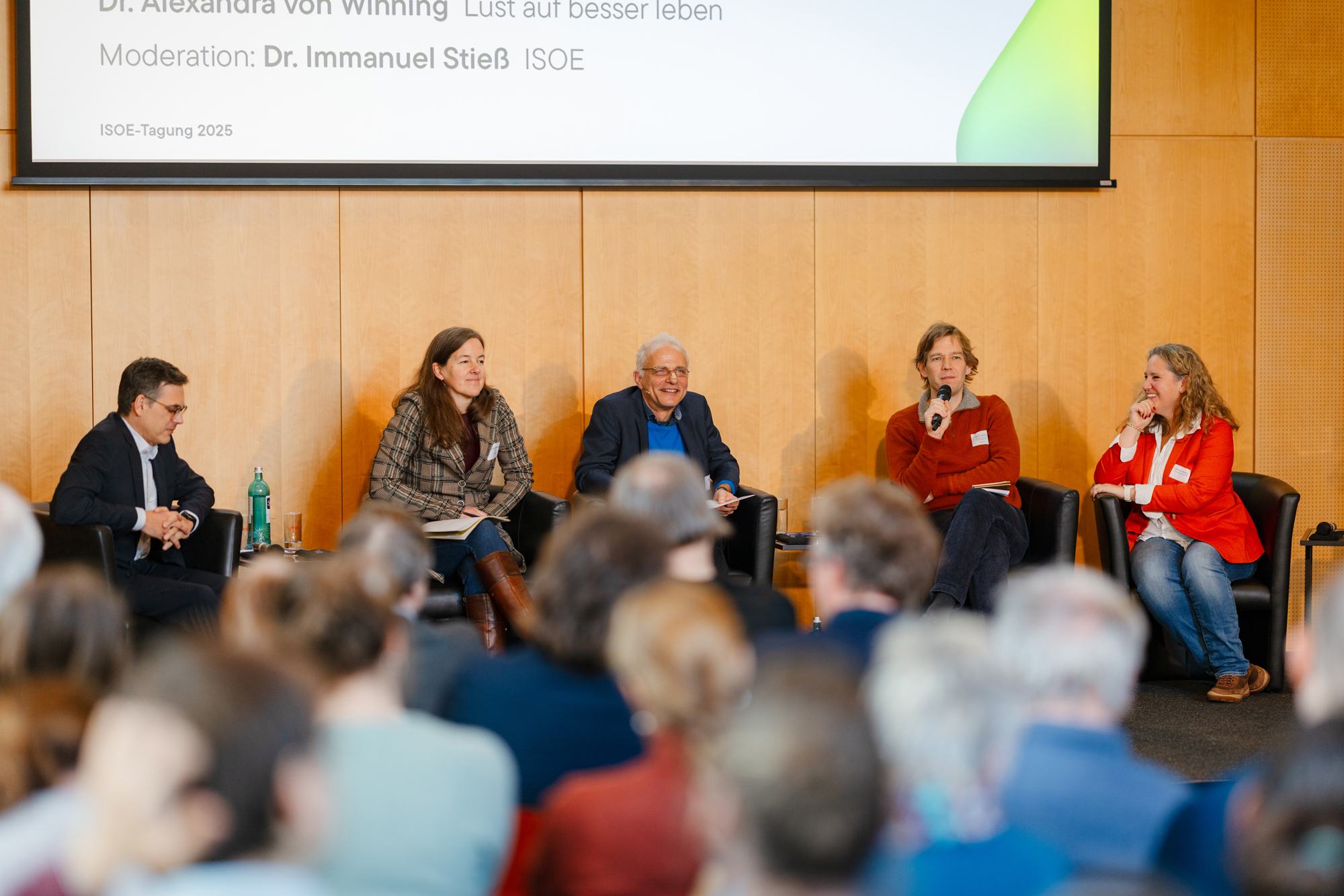
The rise of populist thinking, targeted disinformation, and the manifold attempts to delegitimize social-ecological transformations – many of those present in the packed Haus am Dom made it clear that this development affects them in their work. This became particularly clear during the panel discussion with sociologist Dennis Eversberg, Michael von Grundherr from the Federal Environment Agency, entrepreneur Alexandra von Winning, and Flurina Schneider.
The ISOE conference took these concerns seriously. Concerns that go beyond individual experiences with “headwinds” and affect the stability of democracy as well as the independence of science as a whole. The overwhelmingly positive feedback from conference participants shows how important it was for them to engage in focused discussions with other sustainability actors in an atmosphere of trust. They also discussed why populist narratives are so appealing.
Flurina Schneider pointed out that in times of polycrisis, sustainability issues are no longer among the greatest concerns of many people, who are instead preoccupied with questions of security, defending prosperity, and maintaining status. Right-wing populist actors, meanwhile, have made environmental and climate policy the target of their political agitation. In doing so, they deliberately use the focus on climate and environmental policy as a cultural battleground to deepen social divisions through proxy conflicts and change state structures to suit their own agenda.
Understanding resistance to sustainability issues: “We must become more conflictual”
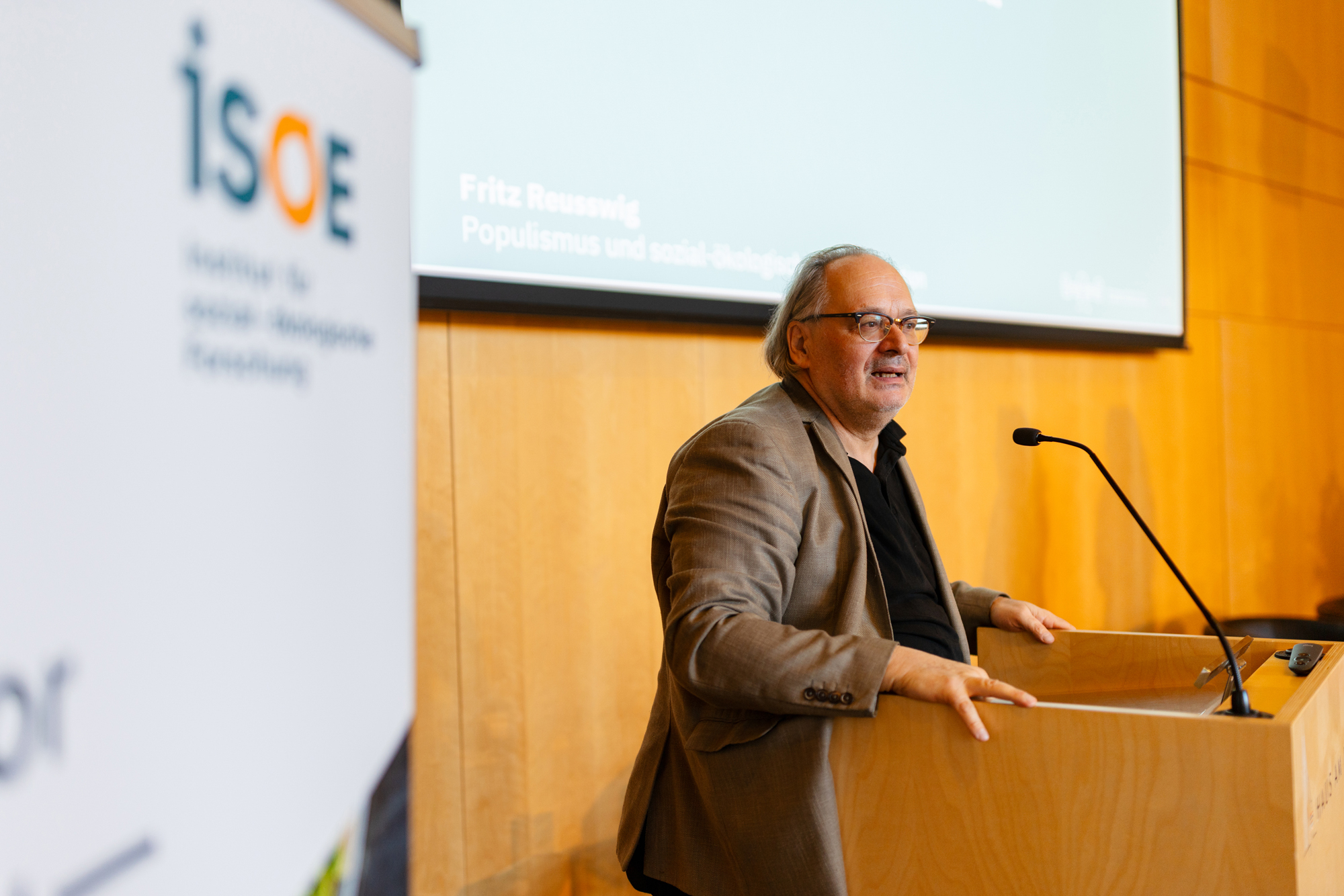
Fritz Reusswig from the Potsdam Institute for Climate Impact Research (PIK) also addressed this dynamic in his inspiring and pointed keynote speech on the topic. He impressively explained the complex interrelationships and dependencies that cause the “structural change in the transformation discourse” through right-wing populist strategies. The sociologist also shared his assessments on how these strategies can be thwarted to some extent:
“Resistance to environmental and climate policy is deliberately initiated and reinforced. To counteract this dynamic, we need to understand more precisely where the resistance actually comes from. Understanding means that we must become more conflictual, reach out to people, and stay in contact with the critical voices that are driving the headwinds. We must recognize and take seriously their needs and underlying values. And we must find out where and how these needs and values can be linked to transformation issues that are ultimately in everyone's interest. For sustainability research, this means thinking more openly about transformations and discussing them across different schools of thought.”
Reusswig emphatically pointed to constructive ways of “turning the sustainability discourse around” by enriching it with positive visions of the future that evoke emotions. With a wink, he therefore called for overcoming the “social-ecological Protestantism” in its severity. By this he meant: less focus on impending catastrophes and more on realistic, positive scenarios that can bring about social-ecological transformations.
In polarized times: Transdisciplinary sustainability research as a role model
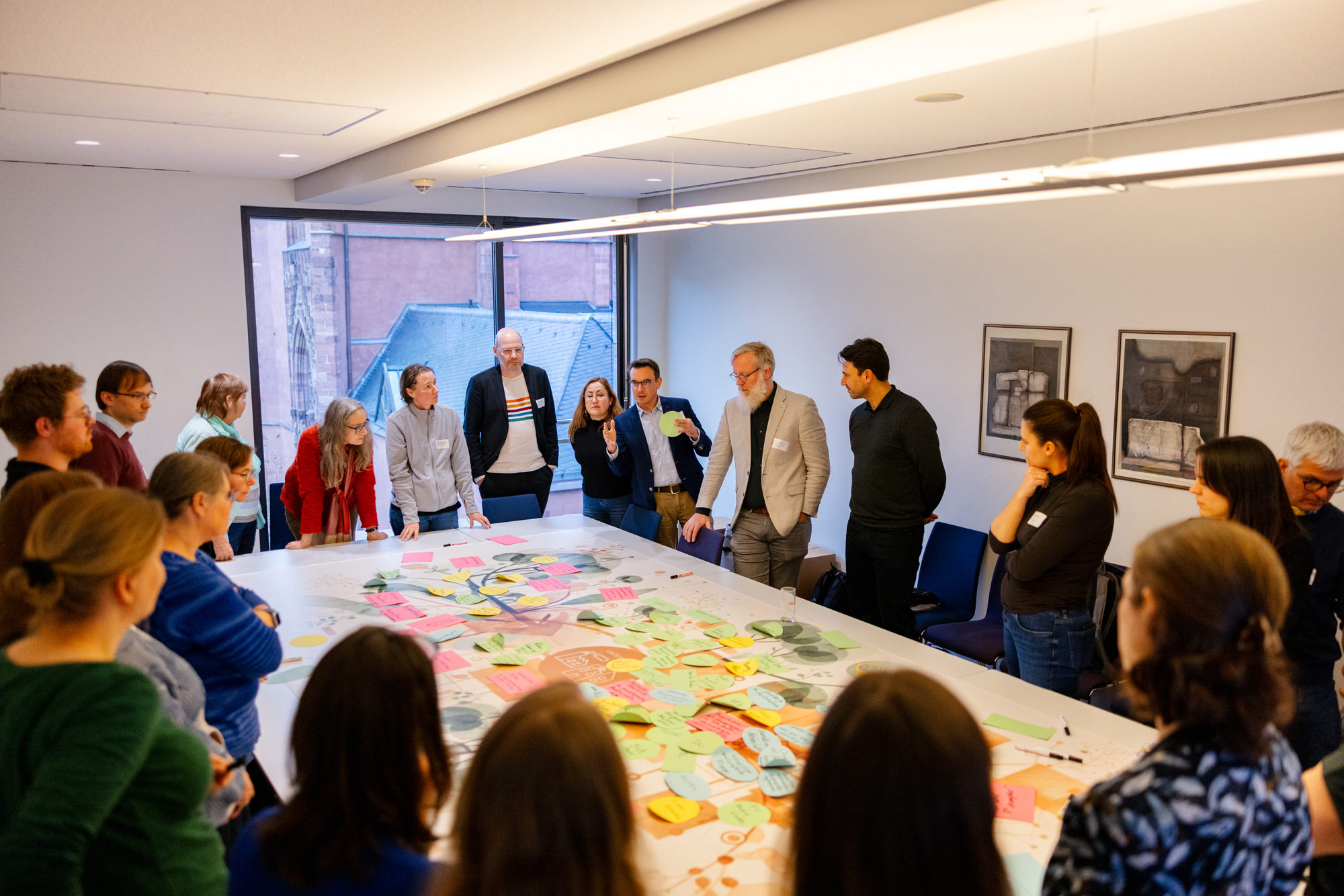
The conference participants took the momentum of this constructive keynote speech with them into the “thinking spaces of transformation,” a format that allowed ample room to develop positive scenarios in specific areas of transformation such as biodiversity, water, and mobility, and transdisciplinarity as a method. In the workshop “Dealing with headwinds,” skills for resilient science were discussed in parallel.
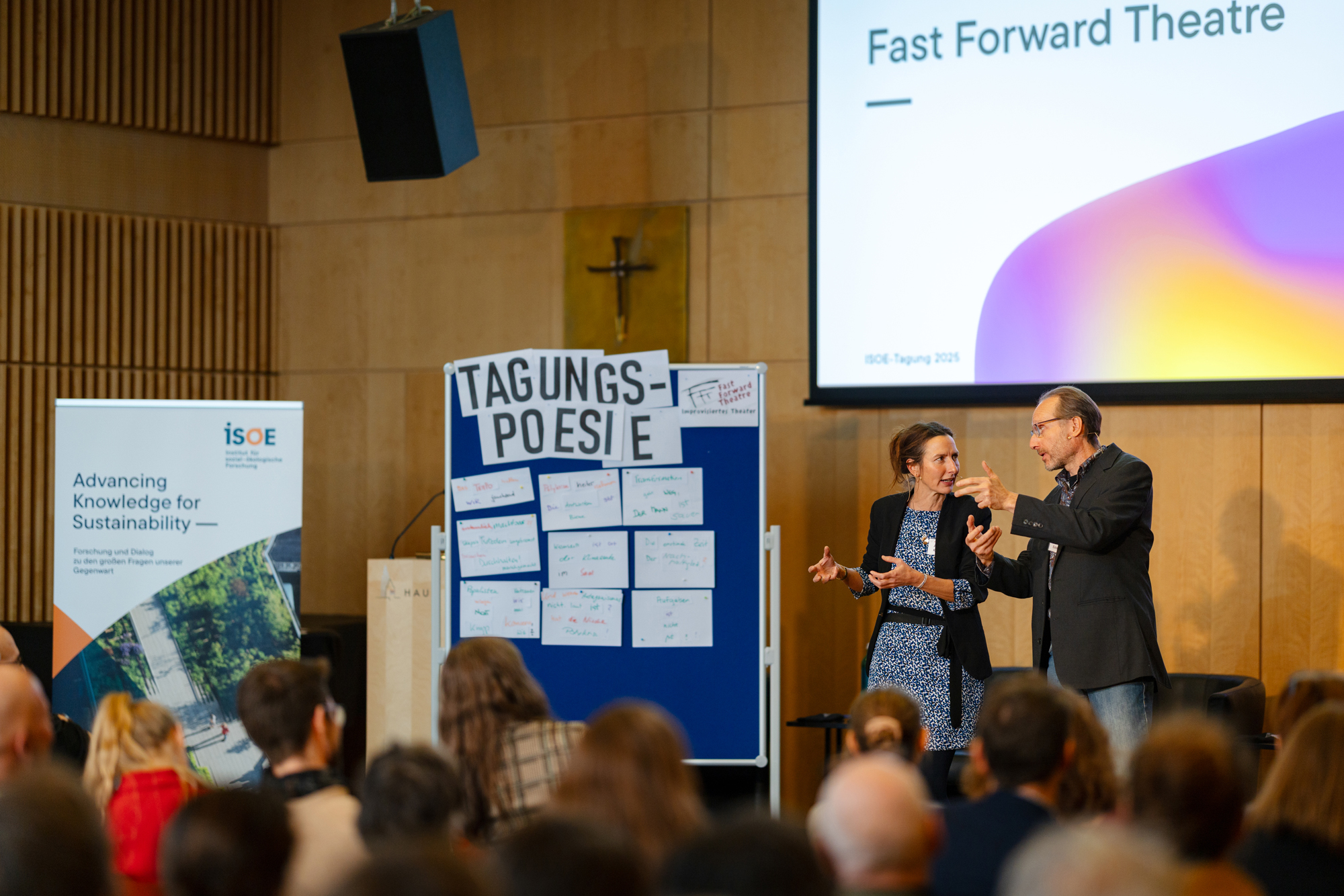
Conference participants used the various, sometimes light-hearted program items, such as the improvisational format “Fast Forward Theater,” for intensive exchange among themselves and concluded that the current widespread skepticism and even rejection of the necessary transformation issues challenges everyone who is actively committed to solving sustainability issues. But when faced with headwinds, it is important to mobilize forces. And the ISOE conference showed that sustainability actors are united by a strong determination to set a new course.
Flurina Schneider reminded the audience that transdisciplinary sustainability research can make an important contribution to this. Because it knows and uses participatory methods and approaches to identify, appreciate, and constructively connect problem perspectives, interests, and solution ideas from different population groups and experiential contexts. In this respect, it can even serve as a model for society and politics:
“I am deeply convinced that there is a need to bring people's perceptions of problems and needs closer to scientific findings about the development of our natural resources. Transdisciplinary research can achieve this. After all, it was developed precisely for complex situations characterized by competing interests, value orientations, and knowledge bases – In order to generate reliable knowledge for dealing with problems. for dealing with problems for which there are no simple solutions.. That is why the transdisciplinary approach incorporates controversial knowledge and perspectives from social actors into research from the outset, because it is clear that solutions for dealing with controversial problems cannot be developed by science alone.”
However, Flurina Schneider also pointed out the challenges currently facing transdisciplinary sustainability research: it must critically examine which research questions are suitable in these polarized times for strengthening a democratic discourse based on verifiable facts. On the other hand, it must be open to a profound examination of the question of how the conditions for free and responsible science can be maintained and how it should behave towards actors who undermine its fundamental principles, such as recognition of verifiable facts, critical thinking, respect for different points of view, open dialogue, and reflection.
Contact:

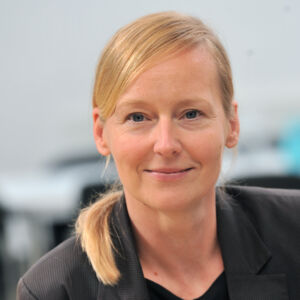
Melanie Neugart
Deputy Head of Science Communication and Knowledge Transfer, Focus Media Relations Go to ProfileFollowing the conference, ISOE offered another opportunity to discuss transformation issues with the soirée “Sustainable, democratic, future-proof? Challenges for the city of Frankfurt tomorrow.” The joint event with the Polytechnic Society Frankfurt am Main took place in the fully booked Haus am Dom. Participants included City Councilor Marcus Gwechenberger, Head of Planning and Housing for the City of Frankfurt, Andreas Hofer, Director and Managing Director of the International Building Exhibition 2027 (IBA'27), Volker Mosbrugger, President of the Polytechnic Society, and Flurina Schneider, Scientific Director of the Institute for Social-Ecological Research (ISOE), was moderated by Judith Kösters (hr INFO) and is available as a video.