ISOE is partnering with Energy Effizienz GmbH to develop an integrated climate adaptation concept for the city of Weimar. The focus is on an impact analysis and the early and continuous involvement of local stakeholders. Scientific findings are combined with local knowledge from administration, politics, business, and civil society in a dialogue-oriented process to develop practical solutions for climate-resilient municipal development.
Research approach
The ISOE team is responsible for stakeholder participation and the impact analysis. Local knowledge is gathered and integrated into the concept development through appropriate participation formats and practical exchange processes. This means that experiences from municipal practice are incorporated, as are assessments of impacts, needs for action, and existing challenges. This dialogue-oriented process strengthens the acceptance of the measures, increases their effectiveness, and supports the long-term anchoring of climate adaptation measures at the municipal level.
Knowledge transfer and interdisciplinary cooperation
The development of municipal climate adaptation concepts serves as a platform for structured knowledge transfer between science and municipal practice. Current ISOE research findings on climate adaptation, water resource management, and the coupling of blue-green infrastructure, biodiversity, and urban nature, as well as communication, participation, and transfer strategies, are integrated into the concepts. The team works in an interdisciplinary manner and closely with municipal decision-makers and other local partners to translate scientific findings into concrete, implementation-oriented strategies. This results in viable solutions that strengthen cities and municipalities in the long term and increase their resilience to the effects of climate change.
Background
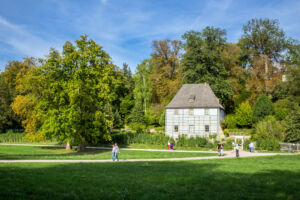
The city of Weimar is an independent city in Thuringia. It is characterized by a high density of World Heritage Sites, classicist architecture, and green parks. The old town is located on a bend of the Ilm River southeast of the Ettersberg. Like many municipalities in Germany, Weimar faces growing challenges from climate change, such as rising summer heat, droughts, and extreme weather events. The Federal Climate Adaptation Act (KAnG), which entered into force on 1 July 2024, obliges the federal states to ensure that climate adaptation concepts are developed for the territories of municipalities and districts based on a sound risk analysis. This is implemented through the respective state legislation. The climate adaptation concept serves as a basis for decision-making when prioritizing measures and ensures that adaptation strategies can be implemented in a coordinated, transparent, and effective manner over the long term.
Research and project partners
Practical partner
Funding
The project “Integrated Concept for Climate Adaptation and Natural Climate Protection for the city of Weimar” is funded by the Federal Ministry for the Environment, Climate Protection, Nature Conservation, and Nuclear Safety (BMUKN) as part of the funding guideline “Measures for Adaptation to the Consequences of Climate Change.”
Links
Contact: