PathChange collaborates with regional and national stakeholders in Germany, Belgium, Romania, and Spain to develop shared visions and strategies for constructively addressing conflicts related to wetland restoration. In doing so, the research project strengthens the synergies between conservation, economic and social goals and facilitates biodiversity-positive transformative change.
Research Approach
The PathChange approach to research is designed as an integrative, participatory, and learning-oriented process between scientific partners and stakeholders from politics, administration, and civil society. The focus is on comparative empirical case studies of selected ongoing and planned restoration measures in the study regions of the four countries.
In moderated stakeholder workshops, the participating stakeholders first jointly identify and assess the subjects of the dispute. Building on this, they develop shared visions and strategies for constructively addressing the conflicts. Additionally, for each case study, the research examines the extent to which relevant governance structures and policy measures prove to be integrated or fragmented, and how this affects conflict dynamics as well as the goals of wetland conservation. The goal is to better align governance structures and policy measures in order to reduce conflicts.
Based on the empirical research findings and their comparative analysis, the research team also develops options for action and policy recommendations at the regional, national, and European levels.
Background
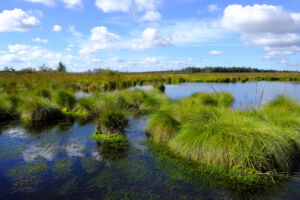
Europe’s remaining wetlands (e.g., bogs, river floodplains, swamps, marshelands) are of great value for biodiversity and provide numerous ecosystem services to society. At the same time, they are highly endangered, for example by river straightening, conversion to cropland, or pollution.
The European Nature Restoration Regulation (EU 2024/1991) offers great opportunities to halt and reverse the loss of wetlands and their biodiversity. However, its success and transformative impact depend on the effective implementation of restoration measures in the EU member states.
This poses significant challenges: in many cases, policy measures and responsibilities are not sufficiently coordinated. Furthermore, restoration projects are often controversial due to conflicts between different stakeholder groups such as nature conservation authorities, agriculture, fisheries, shipping, tourism, civil society groups, and local residents.
Research and Project Partners
- Institute for Social-Ecological Research (ISOE, Project Lead)
- Eigen Vermogen van het Instituut voor Natuur-en Bosonderzoek (EV-INBO), Brussels, Belgium
- Ghent University, Faculty of Political and Social Sciences, Ghent, Belgium
- University of Bucharest, Research Centre in Systems Ecology and Sustainability, Bucharest, Romania
- University of Almería, Department of Biology and Geology, Almería, Spain
Funding
The project “PathChange – Pathways for constructive conflict transformation to foster transformative change in wetland restoration” is funded by the Federal Ministry of Research, Technology, and Space (BMFTR) as part of the Biodiversa+ funding program “BiodivTransform – Biodiversity and Transformative Change.”
Contact: