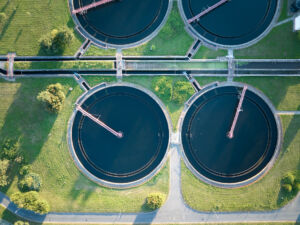
The reSYNERGY research project strengthens the resilience of water and energy systems through cross-sector collaboration. In northwestern Lower Saxony, ultrapure water derived from municipal wastewater is being used for green hydrogen production. Building on existing water and energy infrastructures, a transferable demonstration model for sustainable and crisis-resilient public services is being developed. The research project thus supports the national hydrogen and resilience strategy.
Research Approach
The starting point of the research project is the question of how reused municipal wastewater can be utilized as an additional water resource for hydrogen production to contribute to a more robust, climate-resilient, and sustainable energy supply in the project region by 2035. To this end, reSYNERGY combines technical, regulatory, and institutional innovation approaches into an integrated overall system.
Technical-Infrastructural Level
In a demonstration plant, municipal wastewater is treated into ultrapure water and made usable for electrolysis to produce hydrogen. The technical feasibility, economic viability, and operational safety of the process are being investigated. Additionally, by simulating extreme weather and disruptive events, the potential for resilient and efficient operation of large-scale plants is being analyzed.
Regulatory-institutional level
The project develops governance models for cross-sectoral collaboration between municipal and economic actors in hydrogen production. Additionally, legal frameworks are analyzed and recommendations for action are developed to integrate the use of reused wastewater into regional hydrogen strategies. Participatory processes are intended to strengthen acceptance and feasibility.
Analytical-transformative level
The results of the demonstration plant are evaluated in terms of their socio-ecological resilience. The goal is to develop visions for a sustainable water and hydrogen economy and to derive policy and planning recommendations from them. A regional transformation roadmap for Northwest Lower Saxony outlines concrete strategies for resilient hydrogen production by 2035.
The use of treated municipal wastewater for hydrogen production, as tested in reSYNERGY, combines ecological and economic innovation potential. The approaches developed for coupling water and energy infrastructures as well as for resilient infrastructure management are intended to serve as a model for other regions.
Background
The hydrogen economy in northwestern Lower Saxony is growing rapidly. This places a significant strain on aquifers and exacerbates existing conflicts over water use. This underscores the need to explore new pathways toward a resource-efficient, resilient water and energy supply. To this end, collaboration between the water and energy sectors, industry, and local municipalities is crucial.
Research and Project Partners
- Institute for Social-Ecological Research (ISOE) (Consortium Coordination)
- German Aerospace Center (DLR) – Institute for Networked Energy Systems
- Oldenburg-East Frisian Water Association (OOWV)
- DVGW German Technical and Scientific Association for Gas and Water – DVGW Research Center at the Engler-Bunte Institute of the Karlsruhe Institute of Technology (KIT)
Industry Partners
- EWE Gasspeicher GmbH
- Innovation Center for Sustainability and Production Technology GmbH (INP)
Funding
The project “Cross-Sectoral Use of Municipal Wastewater for the Production of Green Hydrogen to Strengthen Supply Security 2035 (reSYNERGY)” is funded under the “Research for Civil Security” funding program of the Federal Ministry of Research, Technology, and Space (BMFTR).
Contact: