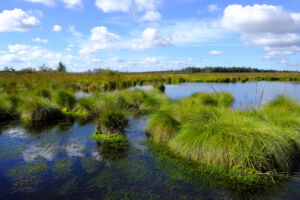
Image: Magica - stock.adobe.com Hochmoor Hohes Venn Eifel
News
Biodiversity Transformation

Addressing conflicts constructively: New research project PathChange on the restoration of wetlands

The PathChange research project develops, together with actors from science, policy, and practice, approaches for the constructive handling of conflicts surrounding the restoration of wetlands.

How can degraded wetlands in Europe be effectively restored when different interests, values, and land-use claims collide? This question is at the heart of the Europe-wide research project PathChange, coordinated by the Institute for Social-Ecological Research (ISOE). The project’s aims is to gain a better understanding of the conflicts that arise during restoration processes and, together with stakeholders from politics, public administration, and civil society to develop strategies for addressing these conflicts constructively. In doing so, the project team is developing socially viable pathways that promote biodiversity and support sustainable wetland restoration.

Wetlands such as peatlands, rivers and streams, floodplains, and marshes are among Europe’s most ecologically valuable ecosystems, yet they are also among the most heavily degraded. They play a crucial role in climate protection, biodiversity conservation, and water balance, but often compete with agricultural land use, regional development, and tourism interests. The restoration of wetlands and other ecosystems is currently gaining increasing political and societal importance. The EU Nature Restoration Regulation, adopted in 2024, now needs be translated into national restoration plans by individual EU member states. However, the implementation of restoration measures is rarely straightforward: as pressures on biodiversity continue to increase, conflicts arise more frequently duet to differing interests, values, knowledge, and responsibilities among the stakeholders involved.

Understanding and addressing conflicts

This is where the new research project PathChange comes in. The aim is to develop starting points under which conditions conflicts in the context of restoration can be addressed constructively. The findings are intended to contribute to the further development of political and institutional structures and processes so that restoration processes can be designed to be more effective, fair, and biodiversity-positive in the long term. The results will feed into both academic debates and political and practical decision-making processes at regional, national, and European levels.

European case studies

The project team investigates restoration processes through comparative case studies in Germany, Belgium, Romania, and Spain. This makes it possible to examine region-specific measures and governance structures, identify commonalities and differences in conflict dynamics, and develop policy and practise of recommendations. The project combines scientific analysis with transdisciplinary approaches: through workshops and dialogue formats involving practitioners, public administration, civil society actors, policymakers, conflict situations are identified, reflected upon, and addressed through the development of strategies and options for constructive conflict management. The project also employs arts-based methods to support these processes. In addition, the research team examines how governance structures influence conflict dynamics and the protection of wetlands.

The research project is carried out by a European consortium of research and practice partners. ISOE coordinates the project and contributes its expertise in social-ecological transformation and conflict research. PathChange is funded by the Federal Ministry of Research, Technology, and Space (BMFTR) and the participating national funding agencies as part of the Biodiversa+ funding program “BiodivTransform – Biodiversity and Transformative Change” and runs over three years.

To the project

Contact:

Apl. Prof. Dr. Diana Hummel

Coordinator for Academic Teaching and Qualification of Young Scientists Go to Profile

Dr. Nicola Schuldt-Baumgart

Head of Knowledge Communication and Knowledge Transfer, Press Spokeswoman Go to Profile
Biodiversity

Biodiversity —

What are the causes of biodiversity loss? How can we protect biodiversity in the future? How can we create a willingness for change?

Go to Topic Page