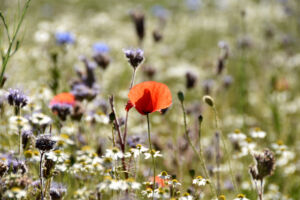
Image: lichtreflexe - stock.adobe.com Insektenfreundliche Wiese
News
Biodiversity Land Use

How Can Agriculture Strengthen Biodiversity? ISOE Supports Living Labs Across Europe

Agriculture has to produce sufficient food while also protecting the climate, soil, water, and biodiversity. In the EU project SAFER, an international research team is investigating how agroecology can contribute to this goal in six European living labs.

How can agriculture remain productive while also contributing to the protection of soil, water, the climate, and biodiversity? The EU project SAFER is exploring this question. An international research team is investigating, in six European living labs, how agroecological practices—such as crop rotations, the creation of wildflower strips, or extensive pasture use—can strengthen local ecosystem services. ISOE is examining which of these services are demanded locally and what ecological, economic, and social benefits agroecological approaches can deliver.

Agriculture in Europe faces major challenges: Climate change is altering production conditions, while biodiversity and soil fertility are declining. The availability and quality of water are also under increasing pressure. Solutions are therefore being sought to secure agricultural production in the long term while protecting the natural foundations of life.

One approach to this is agroecology. It combines agricultural production with ecological processes while also taking social and economic concerns into account. Rather than viewing individual environmental problems in isolation, the goal is to specifically utilize and strengthen the ecosystem services provided by agricultural landscapes to protect biodiversity. These include, for example, natural soil fertility, the protection of water resources, the pollination of crops, and habitats for animals and plants.

Agriculture in Transition: Agroecology as a Solution

Which agroecological measures are appropriate depends heavily on the specific local conditions. In some regions, for example, wildflower strips can promote biodiversity, while in others, extensive grazing can help keep landscapes open and preserve habitats. Nutrient cycling can also contribute to more efficient use of resources.

This is precisely where the EU project SAFER comes in. In six living laboratories in France, Italy, Sweden, Ireland, Hungary, and Germany, an international research team is working together with local stakeholders to develop and test suitable agroecological practices adapted to the respective local conditions.

New approaches are being tested in six European living laboratories

The ISOE is supporting the six living laboratories with a particular focus on ecosystem services. The ISOE is investigating which of these services are particularly important and demanded in the respective regions and how they can be altered through agroecological measures.

Subsequently, the ecological, agronomic, and socioeconomic impacts of the tested agroecological practices are modeled in collaboration with research partners from Norway. Using scenarios, the project examines how different measures could affect ecosystem services and associated agricultural production in the long term.

From Individual Measures to a Multifunctional Agricultural Landscape

SAFER views agroecology as a potential building block of a sustainable bioeconomy—that is, an economic system that uses biological resources without jeopardizing their natural foundations. The project therefore does not merely ask whether individual agroecological measures work. It also focuses on the question of how they can contribute to a multifunctional agricultural landscape.

The results from the six living laboratories are intended to show under which regional conditions agroecological practices can help integrate these various services. In this way, SAFER aims to establish a scientific foundation for how agriculture in Europe can be made more sustainable and what local conditions are necessary to achieve this.

About the Project

The research project “SAFER – Strengthening Agricultural Landscape Multifunctionality through the Expansion of Agroecological Farming in EuRope” runs through February 2029 and is coordinated by the National Research Institute for Agriculture, Food, and Environment (INRAe) in France. It is funded by the Federal Ministry of Research, Technology, and Space (BMFTR) as part of “AGROECOLOGY – Promoting Agroecology in Farming Systems and Regional Agriculture.”
Project partners include the University of Verona, Italy; University College Dublin (UCD), Ireland; the Brandenburg University of Technology Cottbus-Senftenberg (BTU), Germany; the HUN-REN Center for Ecological Research, Hungary; the University of Bergen, Norway; the University of Padua, Italy; Teagasc – Agriculture and Food Development Authority, Ireland, the Leibniz Center for Agricultural Landscape Research (ZALF), Germany, and Lund University, Sweden.

Further information can be found here:
SAFER project page on the AGROECOLOGY Partnership website

To the Project

Contact:

Dr. Marion Mehring

Head of the Research Unit Biodiversity and People Go to Profile

Melanie Neugart

Deputy Head of Science Communication and Knowledge Transfer, Focus Media Relations Go to Profile
Biodiversity

Biodiversity —

Where do the societal causes of biodiversity loss lie? How can biodiversity be protected more effectively in the future? And what encourages people’s willingness to support processes of change?

Go to Topic Page