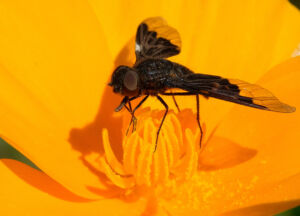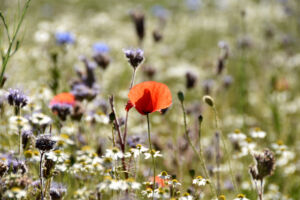
In six living labs in France, Italy, Sweden, Ireland, Hungary, and Germany, agroecological practices are being developed and implemented in collaboration with local stakeholders. The goal is to identify the benefits and risks of these practices and to forecast scenarios for their implementation. ISOE’s role is to quantify the regional demand for ecosystem services generated by these agroecological measures in the six living labs.
Research Approach
A key focus is on developing locally adapted agroecological practices – such as flower strips, agroforestry, or extensive grazing – in the project’s six living labs, analyzing their advantages and disadvantages, and assessing the potential impacts of large-scale implementation.
The research concept is based on four complementary methodological approaches. It follows a transdisciplinary approach through the active involvement of stakeholders. The European network of living labs aims to jointly develop solutions, with a similar landscape-based design being applied in all living labs. Using statistical simulation models and the development of regional scenarios, the impacts of various agroecological practices at the regional landscape level are to be forecasted for farmers and local decision-makers.
The ISOE is tasked with quantifying the regional demand for ecosystem services in agroecological systems across the entire European network of living labs. Building on this, the requirements of various stakeholder groups for different ecosystem services will be identified, and their multifunctionality measured. ISOE contributes its social-ecological expertise to the establishment and documentation of the living labs as well as to the stakeholder analysis.
Background
Germany’s National Bioeconomy Strategy aims at the sustainable use of biological resources to address social-ecological system crises. Agroecology is an approach that integrates ecological, economic, and social goals into sustainable land management. The SAFER research project views this approach as a bioeconomic solution and thus contributes to achieving the UN Sustainable Development Goals.
Research and Project Partners
- National Research Institute for Agriculture, Food and Environment (INRAe), FRANCE (Coordination)
- University of Verona (UNIVR), ITALY
- University College Dublin (UCD), IRELAND
- Brandenburg University of Technology Cottbus-Senftenberg (BTU), GERMANY
- HUN-REN Centre for Ecological Research, HUNGARY
- University of Bergen (UiB), NORWAY
- University of Padova (UNIPD), ITALY
- Teagasc Agriculture and Food Development Authority (TEAG), IRELAND
- Leibniz Centre for Agricultural Landscape Research (ZALF), GERMANY
- Lund University (LU), SWEDEN
Practice Partners
SAFER follows a transdisciplinary approach: Over the course of the project, farmers, residents, advisory services, researchers, and decision-makers will be involved in the research process across the six living labs.
Funding
The research project “SAFER – Strengthening Agricultural landscape multiFunctionality through expansion of agroecological farming in EuRope” is funded by the Federal Ministry of Research, Technology, and Space (BMFTR) as part of the funding initiative “AGROECOLOGY – Promotion of agroecology in agricultural production systems and regional agriculture.”
Links
Contact: