To reduce the risk of mosquito-borne diseases, it is crucial to raise awareness, improve public knowledge, and encourage preventive behaviors such as breeding site reduction within communities. The PuMo pilot project focuses on schools: in a teaching module involving practical fieldwork, pupils learn to identify and eliminate breeding sites, and then pass on their knowledge as multipliers. An intervention study at four schools in Frankfurt am Main is investigating the effectiveness of this approach.
Research approach
PuMo is designed as a pilot study and combines entomological monitoring with social science surveys and educational approaches. In the school gardens at four secondary schools in Frankfurt am Main, entomologists from Goethe University collect data at three different points in time to assess mosquito breeding and habitat availability.
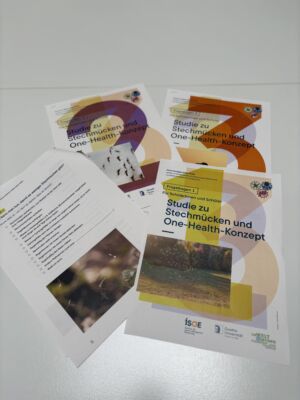
Together, the three project partners are developing teaching materials on the life cycle and breeding sites of mosquitoes, the diseases they transmit, and ways to remove mosquito breeding sites. This forms the basis for a teaching unit that combines theory and practice: The pupils learn to identify mosquito breeding sites and to remove them by hand.
Using a standardized questionnaire, social scientists from ISOE investigate pupil’s knowledge and motivation: regarding mosquitoes and their breeding sites, their role as disease vectors, the One Health concept, and measures to control mosquitoes. The survey is conducted for three points-of-time at each school: immediately before the teaching unit, a few days afterwards to measure initial knowledge gains, and several months later to assess long-term retention and impact. Together with the monitoring of breeding sites, this reveals whether the intervention improves knowledge and behaviour in the short and long term.
Background
Mosquitoes can transmit diseases such as the West Nile virus; furthermore, invasive species such as the Asian tiger mosquito (Aedes albopictus) are spreading. Eliminating breeding sites at an early stage and controlling mosquito populations is more sustainable and environmentally friendly than the use of insecticides. This helps prevent disease outbreaks before they occur. It is crucial that people know where mosquitoes breed and how they can identify and eliminate breeding sites.
Schools are a good starting point for this. Pupils who can identify breeding sites and are aware of the symptoms of disease can pass on their knowledge at school, to their families and to their friends. PuMo thus follows the One Health approach, which emphasises the close link between human, animal and environmental health. The sampling protocols, questionnaires, and educational materials developed as part of the project will be made publicly available and, with appropriate adaptation, may also be applied to other disease vectors, such as ticks, and to other regions. ISOE is responsible for the social science research in the project.
Research and project partners
- Goethe University Frankfurt, Faculty of Medicine, Institute for Occupational, Social and Environmental Medicine (Lead): Dr. Isabelle Kramer, kramer@med.uni-frankfurt.de
- Institute for Social-Ecological Research (ISOE)
- Umweltlernen in Frankfurt e.V.
Client
The PuMo project – ‘Pupils as Multipliers to Promote Mosquito Breeding Habitat Reduction in Germany’ – is commissioned by the Federal Ministry of Research, Technology and Space (BMFTR) as part of the One Health Platform.
Contact: