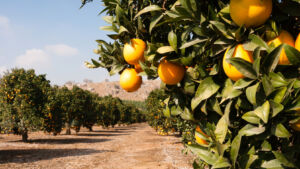
Food production worldwide is heavily dependent on ecosystem services and, at the same time, has a significant impact on these services. To enable companies to better incorporate key ecosystem services into their supply chains, the research project is developing a framework. Starting with selected raw materials, the project consolidates data sources containing available location- and raw material-specific information. This allows for the identification of concrete starting points for the further development of sustainable procurement strategies.
Research Approach
The research project is being conducted on behalf of the company dm-drogerie Markt and under the direction of the Frankfurt Conservation Center (FCC). It examines how the extraction of selected raw materials depends on functioning ecosystem services—and how these dependencies can be taken into account to achieve more sustainable procurement. Based on selected raw materials, the relevant ecosystem services in the respective regions of origin are examined.
The focus is on two things: the impact of raw material extraction on local ecosystems, and the ecosystem services that are particularly important for its stability. A central assumption of the project is that intact and resilient ecosystems can contribute to long-term raw material security. This benefits not only companies and their economic stability, but also biodiversity, climate protection, and the well-being of people in the regions of origin. By highlighting the ecosystem services relevant to raw material extraction, opportunities for targeted nature conservation measures can also be incorporated into the assessment of value creation in the future.
The project has a modular structure. Module 1 is currently being implemented. The goal is to develop a framework that will enable companies to systematically and practically assess ecosystem services in the future. The framework is intended to highlight key interactions and identify concrete starting points for the further development of sustainable procurement strategies. The results will be compiled into an evaluation matrix and a roadmap to support companies in the strategic development of their procurement practices. At the same time, the framework concept lays the groundwork for potential in-depth application and further development in the subsequent modules.
Background
Global food production is highly dependent on ecosystem services such as pollination, soil fertility, water availability, and climate regulation. At the same time, it significantly influences these services through land use, emissions, and resource consumption. However, the importance of ecosystems for food production systems extends beyond their material and regulatory services: nature also contributes to food systems in a variety of non-material ways—for example, through food and culinary cultures, regional identities, traditional knowledge, recreation, or spiritual connections to landscapes. These cultural ecosystem services are closely linked to agricultural practices and regional raw materials.
This is where the research project comes in. It is developing a framework that allows for the systematic assessment and evaluation of the food industry’s impacts on ecosystem services. This framework systematically takes into account nature’s material, regulatory, and cultural contributions to production systems. The goal is to highlight key interactions and indirect drivers along supply chains and to identify concrete starting points for the further development of sustainable procurement strategies. The results will be incorporated into an evaluation matrix and a roadmap. They are intended to help companies better understand the interdependencies and impacts of their procurement on ecosystems and to derive starting points for the further development of sustainable food production systems.
Research and Project Partners
- Frankfurt Conservation Center (FCC) (Lead)
- German Center for Integrative Biodiversity Research Halle-Jena-Leipzig (iDiv)
- Biodiversity in Good Company (BiGC)
Practice Partners
- dm-drogerie markt
Client
The “Nature Aligned Sourcing” project is commissioned by dm-drogerie markt GmbH + Co. KG.