CoDe – Co-Design for a Circular Bioeconomy
How can bio-based value chains truly become circular? The CoDe research project is working in partnership with companies to design strategic pathways for this transformation.
We conduct evaluations to gain insights into the effectiveness, success factors, relevance and acceptance of measures, interventions and offers.
In addition, we use formative evaluations to determine the process quality in the development and implementation of measures and programs. The results of such formative evaluations enable us to optimize the development and implementation process during the project period.
Particularly in environmental and sustainability policy, the social and ecological impacts of measures, interventions and campaigns are often not immediately apparent. Therefore, it is important to record observable effects in order to determine whether and how the developed programs and measures are achieving the desired goals. Analyzing and reflecting on the effects is also important for legitimizing the resources used.
We carry out evaluations and impact analyses either in our own research projects or as contractors. We also conduct accompanying research. Of course, we also examine blockades and obstacles to the implementation of measures in order to draw conclusions for the effective design of projects.
How can bio-based value chains truly become circular? The CoDe research project is working in partnership with companies to design strategic pathways for this transformation.
The project, funded by the German Research Foundation (DFG), is establishing a research infrastructure for social-ecological biodiversity research and developing a long-term monitoring system for social dynamics.
To date, there has been a lack of data on the ecological, social, and tax implications of the current company car taxation system. The project aims to quantify these effects and develop options for reform.
Using new and innovative knowledge transfer formats, the project is developing sustainable solution strategies for a system change in viticulture in the Rheingau and its species-rich cultural landscape.
The project accompanies, supports and evaluates fourteen research projects that deal with measures to reduce plastic in food packaging. Social impact potentials are explored in particular.
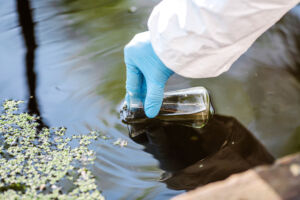
Closing the time gap in monitoring E.coli bacteria in wastewater treatment, among other areas, through near real-time feedback at the disinfection plant.
The mobility transition requires cooperation between political, civil society and economic players. Innovative measures and social innovations are being tested in real-world laboratories.
Working out an example for the conservation and restoration of savannah ecosystems worldwide, the research project investigates how climatic, ecological and social factors drive desertification in Namibia.
The SCIP Plastics research project is developing a master plan for the city of Khulna (Bangladesh) that aims to transform the municipal waste management system in a sustainable way.
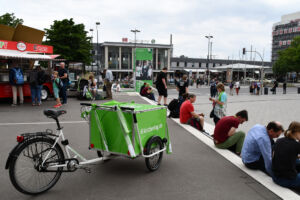
ISOE is researching how train stations can become attractive, sustainable mobility hubs and lively places to spend time. It is developing a modular catalog of measures for their design.
In September, 2024 ISOE was commissioned by the Austrian Science Fund FWF to offer scientists training in transdisciplinary research.
In three real-world laboratories, SuPraStadt II is investigating how the needs of residents in the fields of housing, open space and mobility can be reconciled with the ecological requirements of sustainability.
The LogMob research project is investigating the implementation of an integrated mobility and logistics concept for major events in terms of its potential impact and the acceptance of its measures.
The PendelLabor research project is investigating how commuting between the city and the region can be made more sustainable.
The NamTip project investigates desertification tipping points in Namibia's savannahs, analyzes social and ecological factors and develops sustainable pasture management strategies.
The project sheds light on the dilemmas of sustainability that arise from incompatible goals, interests and types of knowledge and develops guidelines for sound sustainability knowledge.
The aim of the IntenKS research project is to develop an ecologically and economically sustainable concept for the optimized material and energy recovery of sewage sludge.
The aim of the BMBF project is to develop and evaluate resource-efficient wastewater concepts. ISOE is responsible for a fundamental institutional and stakeholder analysis, the sustainability assessment from a socio-ecological perspective and a final transfer potential analysis.
Using citizens' forums and participatory methods, the research project investigates mobility needs and barriers to the use of car sharing, electric mobility & co.
The program aims to promote the capacities of young scientists in Africa for transdisciplinary research and to support scientific contributions to the implementation of the 2030 Agenda for Sustainable Development.
The ARL – Academy for Territorial Development in the Leibniz Association works in an inter- and transdisciplinary manner. Our study highlights the added value of this approach.
The aim of the project is to support the transformation process towards a sustainable, bio-based economy based on natural cycles.
The project is investigating how underused single-family homes in rural areas can be used more efficiently and adapted to demographic changes.
The research network in the BioFAVOR II project demonstrates the technical feasibility of a novel low-tech process for converting faeces from composting toilets into products that are hygienically and ecologically safe.
The project investigates conflicts of interest between health and environmental protection caused by pharmaceutical residues in the environment.
ISOE evaluates water partnerships for climate adaptation, examines joint solutions and develops a concept for transferability to other countries.