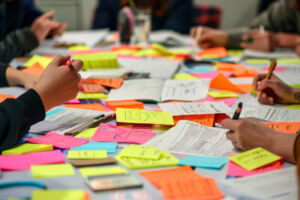
In the “Future Offenbach” research project, young people are working with the project team to develop a vision for a highly diverse urban community. Through co-design processes, they explore their ideas about urban life in the future. Using AI-supported participatory formats and social science methods, the project team investigates how such visions of the future trigger social negotiation processes. At the same time, the project explores how young people can be motivated to actively help shape their city.
Research Approach
By combining AI-supported participatory formats with participatory design processes, the research project is doing pioneering work. At the same time, new approaches to intercultural communication and to the scientific evaluation of design-based future vision processes are being developed. A central innovation of the project is that it views future visions not as static visions, but as open, evolving narratives. These reflect social negotiation processes and can change over time.
ISOE researchers are investigating how everyday topics related to socio-ecological transformation – such as mobility, housing, or community life – can be communicated in a way that resonates with young people and helps them see themselves as active participants in urban development. In addition, the ISOE team is investigating the effects that an interactive future-visioning process can have on young people’s perspectives, identification, and participation, as well as on urban society as a whole.
The project team combines iterative and co-creative approaches from design research and social research with transdisciplinary collaboration. In a first step, ISOE researchers gather young people’s ideas and visions of the future regarding urban life in a highly diverse urban society. These perspectives are then translated, together with all project partners, into various formats of participatory urban design and everyday life. AI-based participatory formats are used to implement design interventions as a starting point for dialogue. Finally, ISOE researchers use qualitative and quantitative social-empirical methods to examine how young people react to these visions of the future, what interpretations emerge, and what new perspectives for social negotiation processes result from them.
The project results are to be adapted as a model for other cities with diverse population structures. Furthermore, the developed vision of the future can serve as a catalyst and initiate new constellations of actors for shaping urban transformation.
Background
In the city of Offenbach am Main, the majority of the young population has an international family history. This so-called superdiverse urban society shapes communal life and opens up new perspectives for shaping the urban future. At the same time, it presents politics, urban planning, and civil society with the task of finding ways to integrate diverse experiences, expectations, and lived realities into shared visions of the future.
The transdisciplinary research project “Future Offenbach” takes a post-migrant perspective. Social diversity is understood not as an exception, but as the norm and as a potential for shaping society. The project’s goal is to work with young people to develop visions of the future for Offenbach that make their wishes, needs, and perspectives on life in the city visible and involve them as active shapers of their urban future.
Research and Project Partners
- Offenbach University of Art and Design (HfG) (Network Coordination)
- Institute for Social-Ecological Research (ISOE)
Practice Partner
- VAIR e.V.
Funding
The project “Future Offenbach” is funded by the Federal Ministry of Research, Technology, and Space (BMFTR).
Contact: